
How to Sell a Coin Collection in Indiana (And getting the most for your collection, not taken advantage of)
Whether you just inherited a heavy lockbox of blue Whitman coin folders in Carmel, found a Ball Mason jar of silver coins in a farmhouse in Lafayette, or are ready to cash in a collection you spent thirty years building, selling coins can feel like walking into a minefield.
Sell to the wrong place like a "We Buy Gold" shop, "Mail us your collection in a fully insured box" or a traveling hotel-room buyer and you can easily walk away with half of what your collection is actually worth.
At Hoosier Coin and Currency, we evaluate collections across Indiana every day. This step by step guide shows you how to figure out what you have in 20 minutes, avoid costly rookie mistakes, and get paid top dollar right here in Indiana.
Evaluated right in front of you • Immediate payment • Call us at 317-362-6754
The 30-Second Golden Rules (Read Before You Touch Anything)
If you only remember three things before selling your coins, make it these:
-
- Put Down the Windex, Dish Soap, Ketchup, and Baking Soda: Never clean, wipe, rub, or polish a coin. Wiping away decades of natural dark tarnish (called patina or toning) leaves microscopic scratches on the metal and can instantly cut a rare coin’s value by 50% to 95%.
- Don't Spend 40 Hours Making a Spreadsheet: You do not need to write down the date and mint mark of every 1940s Lincoln Wheat penny. Grouping your coins into basic piles is more than enough.
- Skip the Hotel Buyers and Pawn Shops: Traveling buyers who rent hotel conference rooms and local pawn shops almost always pay a fraction of melt value and ignore collector rarity.
Step 1: Do a 20-Minute Kitchen Table Sort
Many online guides will tell you to photograph and catalog every single coin before talking to a buyer. In reality, if you inherited 3,000 coins, that will take you three weekends and drive you crazy. It doesn't hurt to take a photo of your collection, but there is no need to take museum quality reference photos of each of your coins.
Instead, sit down at a kitchen table with a soft bath towel laid out (so dropped coins don't get dented) and hold coins only by their edges. Sort your collection into these five fast piles:
-
-
- Pile 1: Pre-1965 U.S. Silver Coins: Look at the dates on your U.S. dimes, quarters, and half dollars. Anything dated 1964 or earlier is made of 90% silver and is worth more than face value, yes even if it is worn smooth. (Tip: Kennedy half dollars dated 1965 to 1970 are 40% silver; separate those into a side pile, too).
- Pile 2: Silver Dollars and Gold Coins: Stack all large Morgan and Peace silver dollars (minted 1878 to 1935), modern American Silver or Gold Eagles, South African Krugerrands, and any older U.S. gold coins.
- Pile 3: Plastic "Slabs" and Mint Boxes: Any coin sealed inside a hard, sonically welded plastic case with a barcode from PCGS, NGC, ANACS, or CACG, along with U.S. Mint proof sets in their original government boxes. Leave everything in its original packaging.
- Pile 4: Old Paper Money & Indiana Bank Notes: Look for oversized paper bills, Silver Certificates (blue seals), United States Notes (red seals), Gold Certificates (yellow/gold seals), or National Bank Notes. If you find an old bill with the name of an Indiana or any state town or bank printed right on the front like The First National Bank of Indianapolis, Fort Wayne, or Terre Haute; set it aside carefully. Do not fold it.
- Pile 5: The "Bulk" Pile: Loose Lincoln Wheat pennies (1909 to 1958), Buffalo and Jefferson nickels, and foreign vacation change. Do not waste your weekend sorting thousands of Wheat pennies by date let our professional trained eyes do the heavy lifting for you. If you have the time. It would be helpful if you brought these grouped in liked kind. Say buffalo nickels in a box or bag of their own.
-
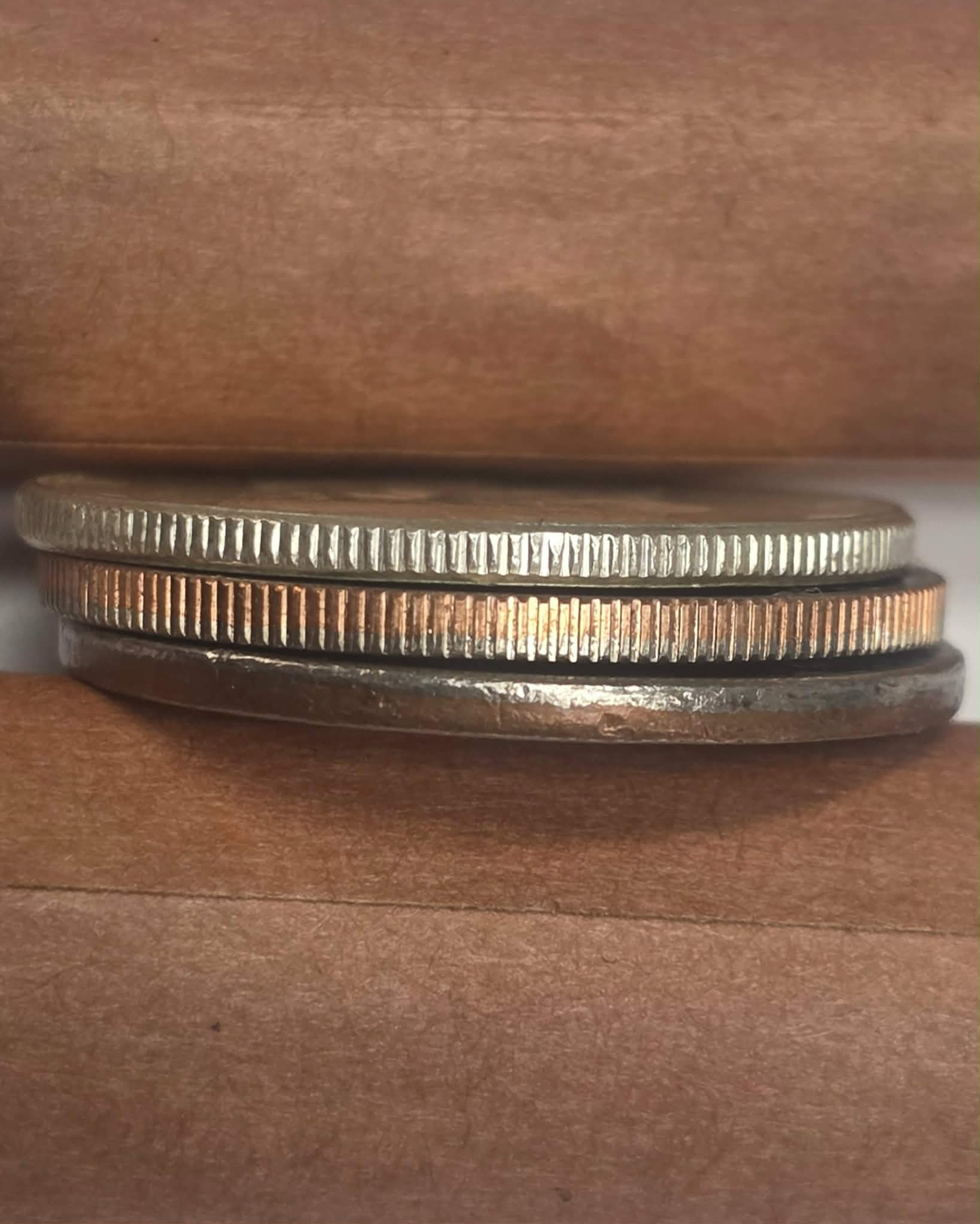
There is a ultimate cheat code in quick sorting through coins looking for silver.
Half dollars, Quarters, and Dimes should have a ridged sides. Starting from the top you have a 1964 half dollar, as you can easily see it is consistantly all once tone in color (all silver). In this example it is 90% your 40% half dollars will present the same on the side as a 90%.
Moving on to the middle coin this is a clad proof 1973 half dollar, you can clearly see a two tones in the ridge an almost gold color and nickel.
Finally the bottom coin. it is a well worn 1983 half dollar you can clearly see an almost brown copper color, with a thin nickel sliver in the ridge. This is also a clad coin. If you see the two tone on the ridge it quickly lets you know you likely have coin worth likely no more than face.
Understanding What Makes Your Coins Valuable Today
It should be stated that not every 100-year-old coin is rare, and not every shiny coin is valuable. When we evaluate a collection in front of you at Hoosier Coin Shop, we price your items using three real-world market factors:
-
-
-
- Precious Metal Melt Value (Your Price Floor): With gold and silver trading at or near historic highs, even common, heavily circulated silver coins and gold bullion have a rock-solid cash floor based on live market spot prices.
- Key Dates and Mint Marks (Your Value Multiplier): A common 1921 Morgan Silver Dollar might bring $20 to $35, while an 1893-S Morgan Dollar in the exact same worn condition is worth over $1,000. A tiny letter stamped on the rear coin tells you where it was struck at. Coin mintages from each mint are well documented.
- Original Condition and Grade: Collectors grade coins on a 1-to-70 scale. Because coins were meant to be spent, high-grade coins that still have their original mint luster ("cartwheel, or proof like") without pocket wear or cleaning hairlines can command premiums.
-
-
Where to Sell Coins in Indiana (Comparing Your Real Payout)
Big out-of-state companies love to claim that shipping your coins to an auction house, or out of state dealer is the only way to get fair market value. What they rarely mention in bold print is their fee structure, or how many months you will wait to get paid.
Here is an honest breakdown of how your five main selling options in Indiana compare:
1. Established Local Indiana Coin Dealer (Hoosier Coin and Currency)
Typical Payout: 75% to 95%+ of real market value (highest rates on gold, silver bullion, and strong collector coins).
Time to Get Paid: Immediate (same day cash or check).
How It Works: You bring your collection in, watch every coin get evaluated right in front of you, see an itemized breakdown, and walk out paid. Zero shipping risk, zero listing fees, and we buy the entire collection—not just your top three coins.
2. Out-of-State & National Auction Houses
Typical Payout: 65% to 85% of the actual sale price after fees.
Time to Get Paid: 45 to 180 days after the auction closes.
Auctions generally only make financial sense if you own an ultra-rare, museum-grade single coin worth $5,000 to $10,000+ where two wealthy specialists might get into a bidding war.
3. eBay and Online Marketplaces
Typical Payout: 82% to 87% (after eBay takes roughly 13.25% in final value fees). You then need to deduct your time, shipping supplies, and postage fees from that)
Time to Get Paid: Weeks or months of listing coins one by one.
The Hidden Catch: You have photograph, list, pack, and ship every item yourself. Worse, online sellers face constant returns.
4. Local Coin Shows
Typical Payout: 50% to 90% of market value.
Time to Get Paid: Generally on the spot.
The Catch: Coin shows are great for selling a handful of graded coins, but lugging around a collection of loose coins table to table will be time consuming and exhausting.
5. Pawn Shops and "We Buy Gold" Strip-Mall Stores
Typical Payout: 30% to 55% of metal melt value.
Time to Get Paid: usually immediate cash
Step 4: How to Handle an Inherited Coin Collection
Settling a parent's or grandparent's estate comes with enough emotional weight without worrying about getting taken advantage of—or having family members argue over who gets what. Over the years, we have helped hundreds of Indiana families, executors, and estate attorneys navigate inherited collections smoothly.
-
- Don't Let Family "Cherry-Pick" Before an Appointment: It is very common for a well-meaning relative to ask for "just a couple of Grandpa’s shiny gold coins to remember him by," unknowingly taking 95% of the entire collection's financial value while leaving the other heirs with heavy boxes of common wheet cent copper. Get the whole collection appraised first so everyone knows the real numbers.
- Check for "Hideaways": Old-school collectors in Indiana were famous for hiding their best coins, inside false-bottom books, or taped inside old envelopes at the back of a safe. Keep all original notebooks, receipts, and paper envelopes you find with the collection.
- Ask About Written Estate Appraisals: If your Indiana probate attorney or trust requires a formal, written fair-market valuation to divide an estate equally among heirs, tell us up front. We provide clear, itemized documentation tailored for estate settlement. We do have a $175.00 per hour fee, that is subject to change. You can ask our current rates for Estate Appraisals.
3 Signs You Are Dealing with an Honest Indiana Coin Buyer
Even if you decide to get quotes from a few different shops around Indiana, use these three rules to protect yourself:
-
-
- Your Coins Never Leave Your Sight: Never let a buyer take your box of coins into a "back room" to evaluate them privately. At Hoosier Coin and Currency, your coins stay on the counter directly in front of you from start to finish.
- They Point Out Your Hidden Winners: The true test of a dealer's integrity is what happens when you don't know you have something rare. A trustworthy numismatist will gladly stop, show you a rare key-date coin or scarce note buried in your bulk box, explain why it is valuable, and price it separately on your offer sheet.
- Zero High-Pressure Deadlines: If a buyer says, "This cash offer is only good if you leave the coins right now," pack up your box and walk out the door. While gold and silver spot prices fluctuate slightly during trading hours, legitimate dealers will always respect your need to think it over or talk with your family. There might be a slight difference in price a day or week later depending on current market spot prices.
-
Frequently Asked Questions About Selling Coins in Indiana
Do I need to pay to get my coins graded by PCGS or NGC before I sell them?
Almost never. Professional third-party grading costs $30 to $150+ per coin once you add up membership fees, grading tiers, and registered insured shipping both ways—plus a 1-to-3-month wait. Unless you have a single coin worth well over $1,000 where its authenticity is in question, we can evaluate and grade the coin raw (ungraded) in our shop and pay you what it's worth without you eating the grading fees.
How is my payout calculated, and how do I get paid?
We sort your entire collection into groups and then put a value on your items based on current market values. After we sort and put a number on your items. We give you our best offer, if you accept our offer. We will then proceed to pay you with a business check, or cash.
Should I bring my entire collection to my appointment?
Yes, you should bring your entire collection to your appointment. This will save you time and effort. Unless you have such a large estate collection the is not feesable to be transported by car to our safe and secure office in Indiana.
Ready to Find Out What Your Collection Is Worth?
Bring your coins, old paper currency, or bullion to Hoosier Coin and Currency for a transparent, face to face evaluation right here in Indiana.
Whether you have three coins or three thousand coins worth of estate lockboxes, we will show you exactly what you have and pay you on the spot if you decide to sell. All with zero pressure and zero obligation.
Hoosier Coin and Currency
192 North Avon Ave. Avon, Indiana 46123
Hours of Opperation :
Monday: 10am - 5pm
Tuesday: 10am - 5pm
Wednesday: 10am -5pm
Thursday: 10am - 5pm
Friday: 10am - 5pm
Saturday: Closed For Time Wit Family
Sunday: Closed For Time With Family
